
Rotator Cuff Surgery Recovery: Week by Week
Rotator cuff surgery recovery week by week: pain control, sling and physiotherapy stages, when it is usually safe to fly home, and key warning signs.
- 12 sections
- 7 questions answered
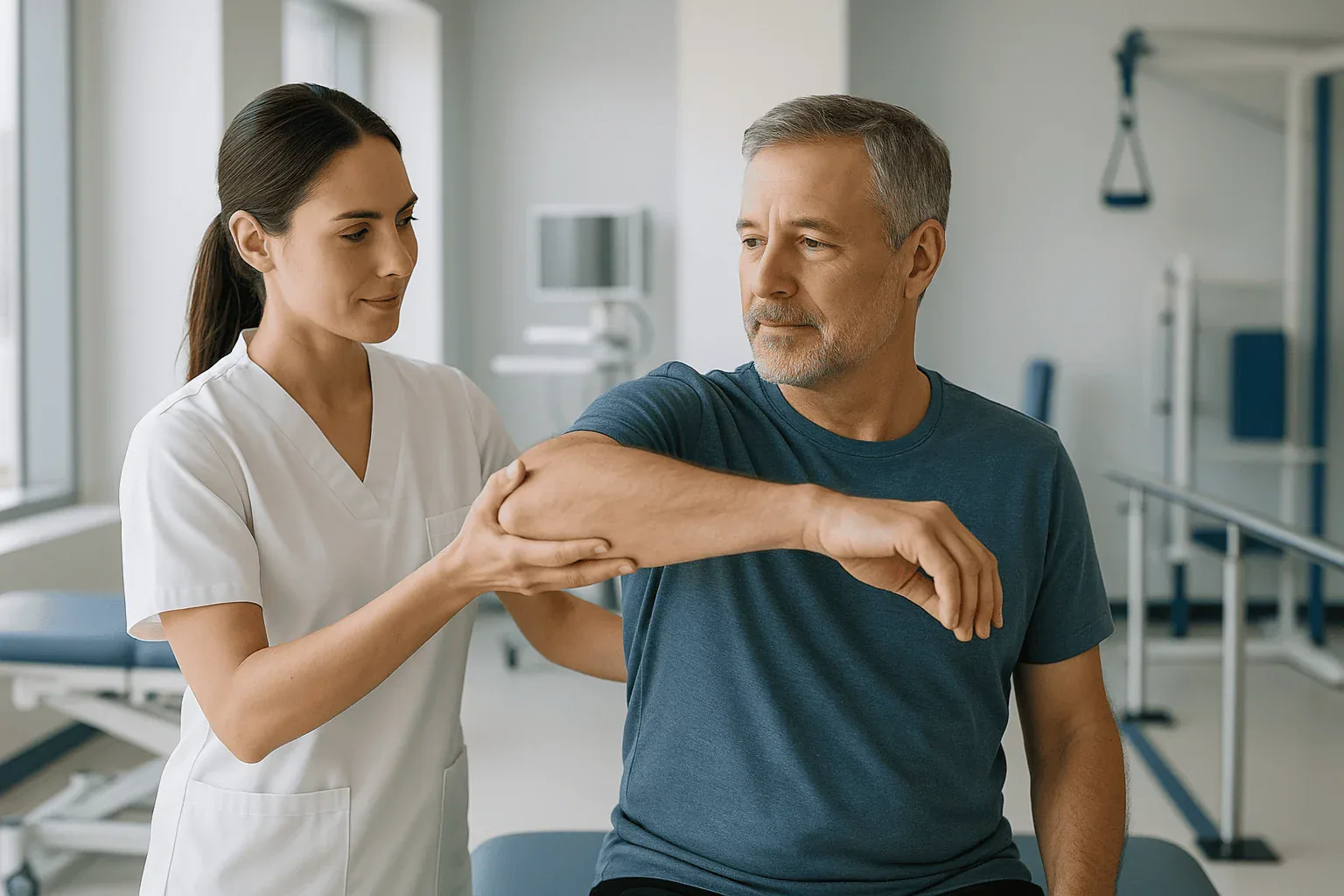
What recovery from rotator cuff surgery actually involves
Rotator cuff surgery reattaches a torn shoulder tendon to the bone, most often through small arthroscopic incisions. The operation itself usually takes 1 to 2 hours under general anaesthesia, and most people go home the same day or after 1 night in hospital. The published recovery time is 4 to 6 months, and the reason is biological rather than surgical: tendon-to-bone healing takes months rather than weeks, so the early weeks protect the repair while the later months restore movement and strength. If you are still deciding between physiotherapy, injections and surgery, this overview of rotator cuff treatment, from rehabilitation to arthroscopic repair explains when each option is usually considered.
Recovery follows three overlapping phases. First, the arm is supported in a sling for several weeks so the repaired tendon is not pulled away from the bone. Second, a structured physiotherapy programme gradually restores range of motion. Third, strengthening begins and return to sport or heavy lifting is introduced step by step under the guidance of the orthopaedic team. Pain control, wound care and follow-up visits run alongside all three phases. Your surgeon’s instructions always take precedence over any general timeline.
Recovery timeline week by week
The first 48 hours
- Pain: usually the most uncomfortable period. Pain is controlled with the medication prescribed at discharge, taken on schedule rather than waiting for pain to build, plus cold packs over the dressing if your team allows them.
- Movement and lifting: the arm stays in the sling. Most people are encouraged to gently open and close the hand and bend the elbow only as instructed. Do not lift anything with the operated arm.
- Wound and dressing: small arthroscopic incisions are covered with waterproof or absorbent dressings. Leave them in place unless told otherwise.
- Eating and drinking: light meals and plenty of fluids as soon as you feel ready after general anaesthesia; nausea usually settles within the first day.
- Washing: a wash at the sink is usually recommended until the first dressing check. Keep the dressings dry.
- Sleeping: many people find a reclined position or propping the arm on pillows more comfortable than lying flat.
- Driving: not permitted while in a sling and while taking strong pain medication.
Week 1
- Pain: typically easing, especially at rest. Most people begin reducing stronger painkillers and rely more on simple analgesia, as advised by the team.
- Movement and lifting: sling worn most of the day and at night. Gentle pendulum or passive exercises may be introduced only if prescribed; no active lifting of the arm.
- Wound and dressing: the first wound check usually takes place during this week. Stitches may be dissolvable or removed at a later visit, depending on the surgeon.
- Eating and drinking: a normal diet. Protein and fluids support healing.
- Washing and showering: showering is usually possible once dressings are confirmed waterproof or replaced; avoid soaking the shoulder. Ask a companion to help with hair washing and dressing.
- Sleeping: continue with pillows or a recliner; keep the sling on unless told otherwise.
- Driving: not permitted.
- Work: some people with desk-based work resume light tasks from home with the arm supported, but this varies and should be agreed with your team.
Week 2
- Pain: usually manageable with simple painkillers; night discomfort is common and typically improves over the following weeks.
- Movement and lifting: still in the sling for most activities. Passive range-of-motion exercises, where the physiotherapist or your other arm moves the shoulder, are commonly continued. No lifting, pushing or pulling with the operated arm.
- Wound and dressing: incisions are usually healed enough to be left uncovered once the team confirms this; any remaining stitches are usually removed around this time.
- Eating and drinking: normal.
- Washing and showering: showering is usually normal, letting the arm hang naturally and avoiding reaching overhead.
- Driving: not permitted while the sling is required.
- Work: light, one-handed office work is often possible; manual work is not.
Weeks 3 to 6
- Pain: most people need painkillers only around exercise sessions or at night.
- Movement and lifting: the sling is usually weaned during this period, typically by around week 4 to 6, at a pace set by the surgeon. Physiotherapy progresses from passive to assisted movement. Lifting remains limited to very light objects, such as a cup, and only when the team permits.
- Wound: scars are usually closed and may be gently massaged with a plain moisturiser if advised.
- Eating, drinking and washing: normal, with care when reaching.
- Sleeping: many people can start to lie flatter, although side-lying on the operated shoulder is usually still uncomfortable.
- Driving: often considered once the sling is no longer needed and you can control the vehicle comfortably and safely; confirm with your surgeon and your insurer.
- Work: desk-based work is usually possible; roles involving lifting or overhead work are not yet.
Months 2 to 3
- Pain: generally low and related to stretching or new exercises.
- Movement and lifting: active movement without assistance is usually introduced, followed by gentle strengthening. Lifting limits are gradually raised by the physiotherapist; heavy lifting and overhead loading are still avoided.
- Daily life: most people manage dressing, washing and cooking independently.
- Sleeping: usually close to normal.
- Driving: usually resumed if not already.
- Work and sport: lighter manual roles may resume in stages. Swimming, cycling and lower-body training are often reintroduced; contact sport, throwing and heavy lifting are not.
Months 6 to 12
- Pain: most people have little or no daily pain by this stage.
- Movement and lifting: strength continues to build and range of motion is usually close to its final level within the published 4 to 6 month recovery time, with further gains in endurance and confidence possible in the months after.
- Work and sport: return to heavy lifting, overhead sports and manual work is gradual and guided by the orthopaedic team, based on strength testing and how the shoulder responds.
- Follow-up: a final review is commonly arranged to confirm progress and release you from formal rehabilitation.
When it is safe to fly home
International patients usually ask about this before anything else. After arthroscopic rotator cuff repair, the earliest window for flying home is typically around 1 to 2 weeks, after the first wound check has confirmed the incisions are healing and pain is controlled with oral medication. Some surgeons prefer a longer stay, particularly after larger open repairs or long-haul journeys.
Timing matters for three reasons. Swelling in the shoulder and hand is usually greatest in the first week, and cabin pressure changes can make it more noticeable. A long flight while immobile increases the risk of a blood clot in the leg, which is higher in the weeks after any surgery. Finally, pain and sling use make it harder to manage luggage and airport transfers safely.
A fitness-to-fly assessment is part of the discharge process. It usually covers wound appearance, pain control, temperature, circulation and sensation in the hand, any signs of clot, whether you can sit upright and move around a cabin, and your medication supply for the journey. The operating team gives the final clearance; no general guide can replace that decision.
- Choose an aisle seat on the side that keeps the operated shoulder away from the aisle, so it is not knocked by passing passengers or trolleys.
- Stand and walk every 1 to 2 hours, do ankle circles while seated, and drink water regularly; ask whether compression stockings are advised.
- Do not lift bags into the overhead locker. Use a small wheeled case and request assistance at check-in.
- Carry in hand luggage: your discharge summary, operation note, imaging on disc or a link, medication with prescriptions, spare dressings, a copy of the physiotherapy plan and the sling fitting instructions.
- Take pain medication before boarding as scheduled, and keep a pillow or rolled jacket to support the elbow.
Warning signs: when to contact your care team immediately
- Fever or chills.
- Redness spreading outward from an incision, or increasing warmth over the shoulder.
- Cloudy, bloody or smelly discharge from a wound, or a wound that reopens.
- Pain, swelling or tenderness in the calf, or swelling of one leg.
- Sudden breathlessness or chest pain.
- Pain that is not controlled by your prescribed medication or that suddenly worsens after improving.
- Numbness, tingling, coldness or colour change in the hand or fingers of the operated arm.
- A sudden loss of the movement you had regained, a popping sensation, or the feeling that something has torn, particularly after a fall or a pull on the arm.
- Marked swelling of the hand or forearm that does not settle with elevation.
Recovering in Türkiye and then at home
Rotator cuff surgery is performed within the Orthopedics & Joint Center at Acibadem hospitals in Ankara and İstanbul. Because discharge is the same day or after 1 night, most international patients spend the remainder of the first 1 to 2 weeks in accommodation near the hospital. Choose somewhere with a lift, a shower rather than a bath only, and a bed or chair that allows you to sleep semi-reclined. A travelling companion is strongly advisable for the first week, since dressing, washing and carrying anything require a second pair of hands.
Before you leave the country, a follow-up appointment with the operating team usually takes place to check the wounds, confirm the sling fitting, review your physiotherapy plan and complete the fitness-to-fly assessment. The international patient team coordinates prior reports and imaging before you arrive, arranges appointments, organises the hospital visit, and sets up the follow-up after you return home. Interpreters can be arranged.
After you return home, follow-up is done remotely with the operating team, typically by video or written update, with photographs of the wounds and progress reports from your local physiotherapist. Take home the discharge summary, the operation note describing the tear and the repair, your imaging, a written rehabilitation protocol with dates for each phase, a list of restrictions, and a medication list. Share these with your local doctor and physiotherapist so that the programme continues without interruption.
Questions to ask your surgeon before you fly out
- How large was the tear, and does that change my sling time or physiotherapy timeline?
- Exactly how many weeks should I wear the sling, and may I remove it to wash or dress?
- Which exercises may I start now, and which must I avoid until the next phase?
- When is the earliest date you would clear me to fly, and does the flight length change that?
- Do you recommend compression stockings or any clot-prevention measures for the journey?
- What is the plan for my stitches and dressings, and can my local doctor manage them?
- When can I drive, return to my type of work, and begin lifting?
- How and when will the remote follow-up take place, and what should I send before each review?
- Which symptoms should make me seek local emergency care rather than wait for a remote appointment?
Was this content helpful? Your feedback helps us improve. Thank you for your feedback!
More patient guides
4 in total


Frequently asked questions
How long after rotator cuff surgery can I fly home?
Most international patients are considered for flying home around 1 to 2 weeks after arthroscopic rotator cuff repair, once the first wound check is satisfactory and pain is controlled with oral medication. A fitness-to-fly assessment is part of discharge, and the operating surgeon gives the final clearance based on the size of the repair and flight length.
How long do I have to wear a sling after rotator cuff surgery?
The arm is usually supported in a sling for several weeks, and many people are weaned from it at around 4 to 6 weeks. The exact period depends on the size of the tear and the strength of the repair, so the operating surgeon's instructions on sling use replace any general timeline.
When can I drive after rotator cuff surgery?
Driving is usually not permitted while the sling is required or while taking strong pain medication. Many people are considered for driving once the sling is no longer needed and they can control the vehicle comfortably and safely, typically from around weeks 3 to 6 onwards, after confirming with the surgeon and insurer.
How long is full recovery from rotator cuff surgery?
The published recovery time is 4 to 6 months. Pain usually settles within the first weeks, range of motion returns through physiotherapy over months 2 to 3, and strength continues to build afterwards. Return to heavy lifting and overhead sport is gradual and guided by the orthopaedic team.
How should I sleep after rotator cuff surgery?
Most people find a semi-reclined position or lying with the arm propped on pillows more comfortable than lying flat during the first weeks. Sleeping on the operated shoulder is usually uncomfortable for several weeks. Keep the sling on at night unless the surgeon advises otherwise, and ask about sleep position at each follow-up.
When can I shower after rotator cuff surgery?
A sink wash is usually recommended for the first 48 hours. Showering is typically possible once the dressings are confirmed waterproof or have been changed, usually within the first week, avoiding soaking the shoulder and reaching overhead. A companion can help with hair washing and dressing during the sling period.
When can I return to work after rotator cuff surgery?
Light, one-handed desk work is often possible within 1 to 2 weeks with the arm supported. Roles involving lifting, pushing or overhead work usually wait until strengthening has progressed, often from months 2 to 3 onwards and later for heavy manual work. Timing depends on the repair and is agreed with the surgeon.
How can we help you today?
Send your diagnosis and reports — a senior specialist reviews them and replies.
Send my reportsMeet an Acıbadem specialist by secure video, before you travel.
Book a video visit